

Our time in St. John was up. It was time for a change. St. John while beautiful is a bit too American tourist at times. We had seen what we needed to and it was time to move onward to Puerto Rico. We wanted to arrive in Isla de Culebra, Puerto Rico in the Spanish Virgin Islands before dark because the entrance to the large bay was riddled with shoals. While there is a channel, you never know how well marked it is, especially at night. Therefore, we planned to depart at 5am for a 36 nautical mile sail to Ensenada Honda. We could anchor just off the town, do some provisioning and maybe treat ourselves to a night out to dinner. I was a little concerned it was going to be slow. Predictwind weather models were suggesting anywhere between 6.5-10 hrs of sailing to the harbor entrance. The winds didn’t look amazing.
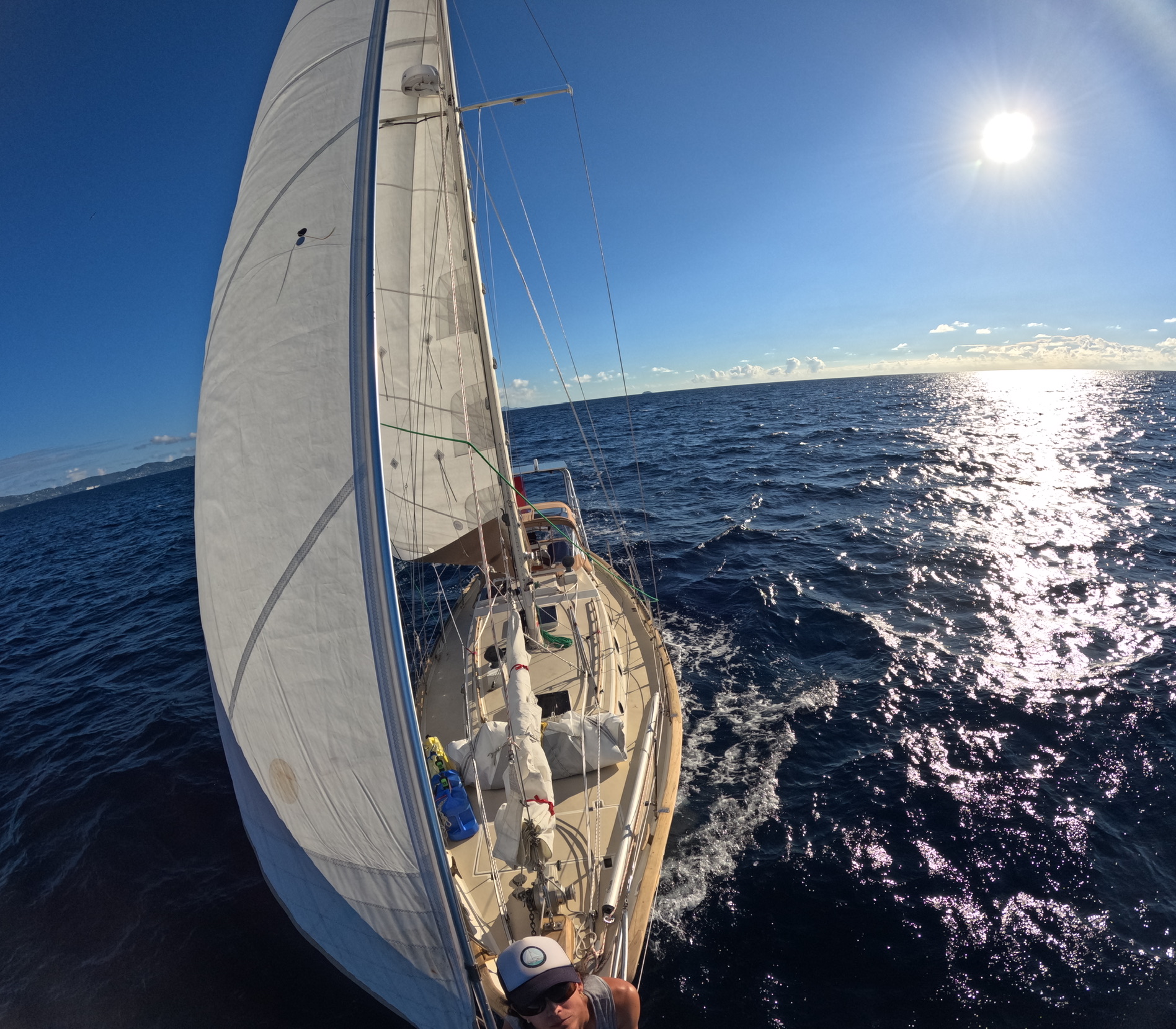
We woke at 4am and it was dead. As usual, the mooring ball had bounced off the boat intermittently throughout the night. To our surprise, once we exited the bay, the wind picked up and it was champagne sailing, downwind at 11-16 knots all day with a relatively stable sea state. We did encounter our favorite friends at dawn, the lovely BMF’s, all headed for port in St. Thomas. Its amazing how they go from a tiny light on the horizon to a towering city in relatively short amount of time. Patience did all the work, keeping a perfect course the entire time. When it came time to change our course, we simply steered the boat by moving the windvane to a position that would bring us to a beam reach on a starboard tack. She really was worth the pain and suffering she put us through!
The evening before we left, I was making some preparations. I went to pull the dinghy to the bow and put her on the foredeck when I spotted two larger fish that almost looked like nurse sharks on the surface. I yelled to Tony, but they were gone before he got on deck. Then we were sitting in the cockpit and we dumped our food compost out and all the sudden they were back, swarming a piece of mango with the Jacks. These alien like creaters were so strange. They had a washboard pattern on their heads and almost looked as if they were upsidedown. We had no idea what they were but after a number of google searches we learned they were Remora, or suckerfish. These were pretty large so it seemed as if they must have to have big hosts, like large rays, sharks, whales, or very large turtles. For the time they were enjoying the food scraps. The ironic thing is, that’s why they host other marine life, to feed off their scraps…

We arrived in Ensenada Honda around 2pm. The channel was well marked and easy to navigate. There is a town dock that seems to be free game for any boat or dinghy, so not long after arrival, we went into town for some provisioning. The small grocery store was packed with goods from floor to ceiling, narrow aisles and extremely busy with lound music blaring. Antiguans, also loved to blare the music in the grocery store, so this was nothing new, but I had never seen so much stuff packed into such a small space. While the line for checkout was filling one of the aisles, they were efficient and we were out of there quick, unfortunately without onions. The produce scenario on Saturday afternoon wasn’t great and Tony was out of onions, but there wasn’t a cebolla to be found on Culebra all weekend. We tried some other stores, to no avail. Onionless we will go. So goes the way of our new life, multiple stores to provision, getting what we can get in these small communities.
After another visit to town on Sunday morning and a few more tightly packed stores we decided to leave the town anchorage for a hopefully more secluded natural spot. This would be Isla de Culebrita, a small island just off the northeast end of Isla de Culebra. There’s an old lighthouse and some cool rock formations with a large beach, and I thought it may be a nice place for Tony to get off the boat while I went back to being a slave to the screen. Monday was the day I would give my notice, but I still had two weeks of work remaining. We arrived on Sunday afternoon to over 60 boats, mostly small power boats all up against the beach. Yes, the music was blaring. There were only 4 other cruising sailboats in the anchorage. I knew most everyone would clear out by the evening. It seems Fajardo, a large city on the east coat of the main idland visits here in large numbers on the weekends. As predicted they cleared out.


Monday rolled around and I was nervous. I would tell SkySpecs today that I am sailing to the South Pacific and my last day would be January 16th. I knew I was leaving a large bonus on the table, but I couldn’t wait for payout. I was tired of the screen and ready to make a change. I needed to take the leap and sail the world before it was too late. I knew I would regret it if I didn’t do it. Tony took a paddle to the beach and hiked up to the lighthouse while I worked. He returned mid-afternoon and around 3pm I had a 1/1 with my supervisor. I was honest about where I was. They wouldn’t let me go so easily. To some minimal capacity, I will stay on as a consultant, a retainer of sorts, to support them at least through 2026, with no major committment attached and some benefits to me. Our journey will continue with a little more padding. That evening we took the paddleboard over to the rock formation where the atlantic rolls into some rock pools. It was low tide, the tourists were gone, we had a rum drink and life was good. We sat on the rocks listening to the waves crash into them until dusk. We hiked back to the paddleboard on the beach and realized we hadn’t turned on the anchor light. Tony sat on the front of the board as I paddled in the direction of the boat, She came into view eventually…

I was feeling pretty relieved, but the anchorage was getting rolly and there wasn’t much more to do here, plus Tony needed onions. We decided we would move back to town in the morning in hope a restock would happen. We also needed to make our way to Vieques, as we had a friend in Puerto Real we wanted to visit. He was headed back to the states for a family visit soon. After two nights at the town anchorage, some onions, and filling up our water jugs at the Dinghy Dock Restaurant, we decided to make the move.
Vieques would be a 26 nautical mile sail, at least to where we needed to go and in order to do it before work, we had to leave early. Another evening of preparation lead to me accidentally dropping a portion of the dinghy paddle in the water (luckily not the paddle part), going after it, falling in and losing it to the 25ft depth of the harbor, which I had no interest in diving. Later I realized my sunglasses went with it. We departed at 3am Thursday morning for Vieques. There was little wind so after getting out of the channel, we motor sailed on a beam reach until our turn downwind at the southeast end of Vieques.
We reached a small milestone that morning. I had bought a whisker pole before we left Antigua. A whisker pole enables you to pole ou your headsail on a run downwind, or even on a broad reach to help eliminate the mainsail from shadowing it and creating an intermittent flap. We had been nervous to use it. It’s a huge 3″ diameter pole that is 10′ and extends out even longer. It attaches to the mast on a car that is on a track, and the sheet of the headsail pushing the sail out away from the boat. We had read so much about how to do this. It was the perfect day, light wind, no waves and I pushed Tony to try it. We rigged it up, somewhat reluctantly, but just nervous more than anything as it seems dangerous to be lifting a giant pole out to the sail up on the foredeck while underway. You do have some control lines so it’s not all manhandling, but still. Regardless, it had to be done. this was a tool we needed as we would continue downwind through the Carribbean and the Pacific. It would increase out speed and mitigate wave / wind shadow flog.

It ended up being relatively simple, but it wasn’t perfect the first time. We learned a few things, fixed a few things and know what we need to do better next time. This includes extending the pole out further, but also trying to clip it to the mast first, rather than the sheet. The article we read said strictly not to do that, but because we have a yankee (high clew jib) instead of a full genoa or regular jib, we think this may be simpler because it needs to be higher on the mast and we do not have a line controled car on the track. It’s old school pin stop and cannot easily be adjusted after the fact.
We arrived in Puerto Real on Isla de Vieques around 11am. I worked the rest of the day and Tony met our friend who has an Eco sailing charter business called Just Today. If you are ever in Vieques and want a true sailing experience on a small boat, Jonathan is your man. He came to the boat for dinner that night. It was a treat to have some company again. We will move to the Mosquito Bay anchorage today, which is a bioluminescent bay. Luckily we have an electric dinghy motor as no gas powered motors are allowed in the bay. We will anchor just outside and check it out tonight. We will likely hang in Vieques until our West Marine order shows up in Fajardo as taking the ferry will be easier than trying to go into the big city area with the boat. No expensive marinas for us!
Discover more from SV Reverie Blog & Merch
Subscribe to get the latest posts sent to your email.

looks great like you are having a good time. Be safe and enjoy the rest of your journey