
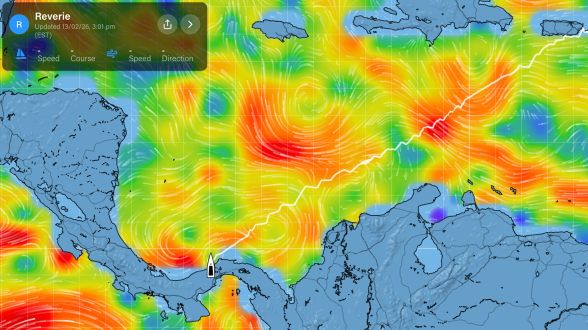
I knew the Caribbean Sea would not be kind to us. Everything I’ve read says the best window for passage is December before the trades build again and pile up off the coast of Columbia where the sea bed drastically rises in elevation. That creates steep waves influenced by the wind and currents resulting in an unpleasant situation. After all this sea is kind of like a bathtub. If you put it in perspective to the larger oceans it’s a small area of curcular currents. The trades come from Africa / Europe across the Atlantic East or Northeast depending on the time of year. Then during the winter, northers blow down from the North Atlantic and the US. It’s not a pretty picture in this bottled up body of water. The currents were something we would realize later that we could have approached differently, significantly reducing the amount of jibing we did, and working a lot less. We are certainly still learning…

The sea is a volatile place, challenging to predict. All the weather models have similar but also slightly different thoughts. No matter how much you look, no date or time looks perfect. You are a slave to the forecast and it never gives you the perfect scenario. There will always be some compromise if you want to get where you are going. You can’t predict that far into the future anyway. We move at 3-7 nm an hour, which is similar to regular miles per hour. Most people can’t even drive their car that slow. While it can feel fast in a boat, it’s basically a crawl over expansive bodies of water that react to every weather change, from prevailing winds to small squalls to large storms. Certainly, you can avoid the worst with weather forecasting, but you will never avoid it all or predict it perfectly. Play the waiting game and you will never go. Reverie is capable. It’s just a matter of whether the forecast is reasonable and if we can handle the endless pitch and roll, the punches thrown at you by the boat and the ocean all at once while simply trying just trying to live.
Menial tasks like brushing your teeth, cooking, doing dishes or using the bathroom are all amplified to another level. Don’t set anything down and hope it will be there if you turn your back for half a second. On day 2, I fell flat in my ass unexpectedly just when I let my guard down standing in the cabin when a wave hit us on the side. That same day, two 5 gallon water jugs we had tied down to some small eyelets broke loose as I was sitting down eating. They flew across the cabin, crashed into the refrigerator and the tops exploded off of them. Water everywhere. I leaped for them to stop the next explosion created by the roll. That took both of us to deal with since I literally couldn’t move while holding the jugs to keep them from sliding anymore. One water container didn’t survive and we ended up losing half of it because it was too violent toTry and dump It in the tank on deck. Luckily we had plenty of water.
The experience of being in the cabin is tough to explain, as it requires one to experience it to truly feel the chaos. Everything is amplified down there. If we are rolling, it’s twice as bad below. The noise is extreme. Trying to sleep down there when the sea is this volatile is extremely challenging. At times it can sound like the rig is coming down when everything is fine. The bulkheads creak constantly, worse on a port tack than a starboard tack because of their location. It’s like you can hear the fiberglass twisting and turning, compressing and breathing. As the Captain, I’m jumpy. The noise has made me think more than once I needed to jump out of bed because something terrible was happening when in reality, the headsail was just flogging.
All these challenges make you realize just how easy we have it. The harsh reality of the ocean puts life in its current state for a white American into perspective. You have to work harder to survive in many aspects. Yet at the same time we are privileged to be able to make a choice to go on this journey. It’s strangely ironic. ?? Don’t get me wrong we worked hard to be here. It wasnt handed to us in that sense of privelage. Instead it is the freedom we have been so lucky to have been given combined with the potential for prosperity.
We tried something different on this passage with the watch shifts. We had always done 3 hrs on 3 off, but you never really sleep. By the time you are getting to sleep, it’s time for your shift again. Tony’s idea was to do two 6 hr shifts and the remaining in 3. This allows one longer sleep for each of us. The main issue with this is that I sleeep like a grandma and would unlikely be able to ever take a 6 hrs shift early in the night. Tony volunteered to take 9pm to 3am. I can get up at 3 no problem and do 3am to 9 am. I couldn’t believe he could hang for those 6 hours, but he was able to, most of the time. This is a huge difference for our rest cycle.
The details of each day follow. For those that have been tracking us on our Predictwind tracker, many of these notes are the similar or the same, with some images included. This post is a bit lengthy in comparison. There is a lot to unpack…
Night 2 – February 5th
After multiple days of cloud cover, including prior to our departure, we finally have a clear sky. The sea state has calmed but it is still slightly inconsistent. Downwind it’s downright rolly, on a broad / beam it’s not too bad. Lucky for us the wind shifted enough to allow for us keep this course easily.
Our wind instrument is old and not performing well. It continues to randomly decide it will not read true and apparent wind separately and we get one number for both. That number doesn’t even seem accurate based on what I can feel. It’s not the first time this has happened with it, but it’s been a low priority item (later I learned it’s more likely our Transduccer not reading speed through the water, which is also our depth sensor that has been an issue). Patience continues to be the star of the show, even if every now and then she struggles in sloppy seas. The struggle is slight and nothing compared to our hydraulic autopilot, which wouldn’t even be able to perform. In those conditions. While we may not need it, the reef in our mainsail remains. The wind has dropped for sure, but given the health of the sail, I’d rather be safe than sorry, especially at night.
Sleeping hasn’t gone great for me. The noise down below continues to wake me constantly. I’m considering sleeping in the cockpit tomorrow night. The sound of the wind and waves is so much more pleasant.
A few small flying fish have met their demise on our deck. I always feel bad that this random small vessel sailing by is murdering the flying fish. It’d be a totally different story if I was a Brown Booby in search of dinner. The Brown Boobies have been around here and there. Between them and the flying fish, we haven’t seen anything else, not even a cargo ship. The last radio transmission was yesterday afternoon when the US navy was telling a vessel to move 8 miles east out of their practice area. The radio transmissions have stopped. We are now too far offshore. We took the staysail down because it wasn’t aiding our downwind course.
Day 3-
We were visited by a pod of small dolphins this morning. They were petite and were feeding around the boat. Tony got a little parting gift when one of them jumped and twisted out of the water, like something out of sea world. Later in The day we were visited by an entirely different kind of animal. A US military jet flew so close, obviously they saw us, as they turned to get a look, I could almost see the pilot through the glass. I waved. This is the second time one of those jets has flown close to us, but this one was much closer. Yesterday one flew close to us as well and definitely took a look but at a farther distance. We sailed on a beam reach all day at 4-6 knots. It was much more comfortable than the previous day. Still the sea state is imperfect.
Night 3 / Day 4-
The wind shifted and died right as my shift started at 2 am. I scrambled to keep the sails from flogging, nervous our mainsail would rip further and closer to our first reef. It’s kind of a losing battle, but I managed to settle them slightly and the wind became consistent, yet still low. It continued most of my shift and I was forced to jibe at one point to see if the sea state would change the boat movement at a different angle. Dawn brought some consistency in the wind, but it remained low. I managed to make us breakfast, potatoes, bacon and eggs. Tony went down for a nap around 11am and by 12:30pm the wind was fluctuating, the sea state creating roll and the sails were flogging inscecently. I decided to wake Tony to try to put the whisker pole up. We tried every point of sail. Wing on wing was simply too rolly and the sails were flogging worse every time the waves pitched the boat sideways. A starboard tack was ok, but the sea angle and heading was not ideal. Last resort was port tack pole out. It seemed to be slightly better so we left it. We continued to slowly make way at 2-4 knots. It definitely helped us keep more consistent speed and kept the headsail from being shadowed by the main. Before dusk we dropped the pole.
Unfortunately, because we have had to change course so much it didn’t seem like a good idea to leave it up all night or we would be stuck on that tack with no options. It’s challenging enough getting that thing down in daylight with a rolly boat, lets alone under darkness. When the winds are low, this seems to get us another knot or two of speed. The downside is changing course. It requires moving the pole over to the other side of the staysail stay. This means, furl the headsail, go to the bow, remove forward and aft guy lines, drop the pole on the sheet end, maneuver it around the stay, clip it to the other sheet, raise the pole, attach forward and aft guy lines, then unfurl the sail. This means changing course often just isn’t ideal. But during the day, it’s worth some hassle. We just have to stay on the same tack for longer (if we had used the currents and stayed on one course for longer we could have avoided this. It means more miles, but potentially not any sower). Low winds continued throughout the night. The swell got smaller. I finally slept. This time in the V- berth. The mainsail is surviving. I made some adjustments this morning to the reef line and lazy bag to protect it more, but we discovered a rip right at the repair below the first reef.
It’s not been an easy start to this passage. The comfort level is not great. The sea state continues to be inconsistent and confused. There is definitely a primary swell, but it’s a short period and there’s other waves coming in occasionally from a different direction. It looks like a jumble of peaks and valleys. I’m really hoping this is just a Caribbean Sea problem. I’ve never seen a clean swell in this sea except one time in St. Vincent between the main island and Bequia where the Atlantic meets the Caribbean. That time the swell was beautiful. HUGE rollers running at a long period. The boat next to us would disappear in the valley of the swell. I long for something like that now. The flogging continues to be a fight. I look forward to the wind coming up tomorrow afternoon. I should be careful what I wish for….
Night 4 / Day 5
It was a calm night. Calm in the sense that there was no wind and the sea state was the most comfortable it had been. The boat was not calm. The constant sail slap and flog was ever present. We had moments where little bursts of wind came and we sailed along for a little bit. In the morning we put the pole out. A spinnaker would probably be best in this situation. We do have an old spinnaker that’s buried in the garage. It looks like it came out of the early 90’s, neon rainbow colored. We haven’t tried to put it up since the passage to Antigua when it got stuck in the sock, nor have we pulled it out and ensured that would happen next time we tried. Too many other things going on. I think it’s time we at least try it. We can’t afford a new one now that we have to buy 3 other sails and why not use what we have if it will work. That will be the next learning experience, but at the moment digging it out of the back of the garage (I.e. quarter berth), feels like a lot of work and we have no place to ensure it is going to deploy properly. The wind is supposed to come back up this evening. Crossing my fingers we can start making good ground again.
Night 5 / Day 6
It rained hard in the evening giving Reverie a much needed bath. The winds continued to be low and we did a lot of bobbling and flogging. This may be one of the hardest parts about sailing, feeling like you are getting nowhere and listening to the rig bang around. You try everything to ease the banging, but it’s generally a losing battle. It seems the wind went up and down for Tony’s shift and when I came up at 3am we were hosting a visitor. A bird had found a resting place for the night on our solar panels. It remained there until dawn. I managed to capture an image with the GoPro on a pole just before it flew away and just as there was barely enough dawn light. Yesterday the rain squalls didn’t produce much wind and I was wishing they had since I was becoming sick of the rolly flog. Today is different. The squalls were present at dawn and the winds are up and down. The sea state has risen because of this and I had to reef the headsail just after breakfast quickly. Patience was on setting #1 for lowered winds and was struggling to steer us so she threw us into the wind and the boat heeled significantly, my immediate cue to act. I tried moving her to the # 2 setting but she was still struggling when the wind rose yet again. Now we are settled into #3 and with the reefed headsail, an ease of the main and a little help from the helm we are back in motion on a broad reach doing 5-6 knots.


Night 6 / Day 7
As expected the Caribbean Sea reared its ugly head last night and continues to do so. Luckily we were prepared. We put the second reef in the mainsail late yesterday afternoon. Just prior to that we jibed and the headsail curled around the forestay the opposite way. We think this caused the furling line to foul itself inside the roller because when I tried to reef it more it was getting stuck. Tony went forward to take a look, we unfurled it all the way, and re-furled and it seemed to fix the issue. Then we were going to heave to to add the second reef when I had a complete brain fart on how to deal with the helm in order to heave to. This caused an accidental jibe. Not a great afternoon. After a breather we hove to and reefed easily. It wasn’t too bad before nightfall and then it steadily got worse. We saw, what we believe to be the apparent wind, reading hit 30+ knots at times, luckily it was inconsistent, but this suggests the true wind speed was at gale force. It was consistently in the mid 20’s all night and the sea state continued increasing. We saw another sailboat on AIS, SV Niffler. They were right next to us about 1 nm off. They passed us, then dissappeared. Sleep was not a thing last night and I had to come up and help Tony jibe multiple times. We are a team after all and these conditions required two sets of hands. Reverie and Patience are handling this all quite well considering.
If we didn’t have Patience we would certainly be hand steering. We sometimes have to help her through the waves, or when the wind gusts, but otherwise she is a savior. Even with the moon out at the end of the night you still couldn’t quite make out the sea state. I knew at dawn she would be quite the sight. We have a pretty steep 2.5-3 meter swell that is sloppy with breaking waves. The wind can be seen on the surface of the water. It forms ripples and a mist. For some reason I have been the lucky one to take on the couple breaking waves that have come into the cockpit. Starting yesterday afternoon, I was dosing off when rouge one came over the side and hit me head on. Very early this morning it happened twice. Tony has only experience spray. Lucky him… It’s a startling experience. We made up for lost time in the last 24 hrs m, and clocked a total of 170 miles. We have slowed slightly due to the reef in the mainsail and the roll created by the sea state, but we still surf down the face of bigger waves and make up for it at 8-10 knots. We are about 250 miles out. It looks like this puts us at our destination right in the middle of the night on Wednesday / Thursday if we keep up the pace. I’m not happy about that. The conditions are not going to improve much. The wind is supposed to peak today, but then doesn’t go down much afterwards. The period of the swell is supposed to increase, which is a plus. The waves will hopefully be a little more consistent, with more time in between. Just as I finish this post Tony screamed “dolphins!” I went up to poke my head out to find them surfing and jumping out of the huge swell. We needed that…
Night 7 / Day 8
It was a wet and salty day yesterday. Luckily, the sea state subsided a bit by late afternoon. The larger sets became more infrequent, the boat rounded up less and we took less waves onto the deck. The more I thought about it, the waves seemed consistently a bit bigger than forecasted. From trough to peak they appeared to be at least 15-20 ft. Seeing those dolphins surf in them gave them even more perspective. It’s nearly impossible to capture it on video. It simply doesn’t do it justice. Regardless, we were glad we were going into the evening with a slightly calmer situation. The winds had also subsided slightly. No more gusts above 26 knots. We decided yesterday that was the most true wind speed we have experienced to date. Certainly some of our upwind sailing around the Florida straights was as bad, but you create more wind on an upwind course.
There is this beauty in the power of the waves. They have a sort of magnificence to them that you can’t quite explain. The sound of water rushing, the wind blowing, the face of the wave as it rises and then collapses are all a force of nature that leaves you awestruck. Granted it’s also tiring and sometimes frightening to be in them, to move around the boat, to simply live in their fury.
The flying fish became more frequent a few days ago. I was in the head and it smelled really strongly like fish. There’s a dorade vent in the ceiling, which on deck is shaped like a horn. I immediately thought a flying fish must have flown into it. The smell was definitely coming directly from it. Due to the weather we left it for 24 hrs, but yesterday afternoon Tony went forward, stuck his hand in and pulled out a flying fish. Poor guy had great aim.
Then last night on my early shift I was standing near the helm and one flew into my chest. It startled me and I squealed. I continued to squeal as I tried to save the slippery little guy. Seems others may have done it at the same time because we found two more later that were not saved. It was dark :(. This morning I collected 25 flying fish from the deck. Could be a mix of breaking waves and them flying on board. And here I was worried about the 2 that I didn’t save. *Note: I pulled at least another 10 later off the deck hiding, then once we arrived in shelter bay the flies told us there were more under the dinghy, another 5…

Yesterday afternoon we were visited by anothe Brown Booby. It fed for around an hour, soaring back and forth in between the waves, and overhead in circles around the boat, diving in for those delicious flying fish. We watched it catch a fair share. It was the best entertainment all day long.
This morning we still have a reasonably sized sea state. The winds are at 15-22 knots (apparent). There’s some clouds in the sky and I’m hoping for a hard rain so we can wash some of the salt away. The boat has become slippery, inside and out with salt. While we didn’t experience as much wet inside this time vs the short passage from Dry Tortugas to Marathon, we do have a few areas weeping, one of which is known and we have not seen it weep much since then. It’s just below where the scupper is on deck so I’m assuming that’s the culprit. Enough water on deck and a 46 year old boat is bound to weep somewhere.
We are 135 miles out. We might get lucky and arrive just before dawn, or once it’s light tomorrow. We do have to sail more than 135 miles since our course is directly downwind, so jibing back and forth to keep on course adds distance. We are headed into Shelter Bay Marina at the mouth of the Panama Canal. We are looking forward to a real shower.
Day 9
Land Ho! And many BMF’s…
We struggled to make good progress yesterday. The wind wasn’t terrible but I think the current affected us in the afternoon. The morning had a large swell, still a little on the steeper side, but by afternoon, it had rounded out and we had a few hours of champagne sailing with beautiful large following seas. We had another dolphin pod encounter. They hung out for quite a while.
It started becoming clear we were nearing Panama when more cargo ships and tankers started showing up. Again the wind was dying and the current was affecting our forward progress. It was extremely frustrating. We were so close yet so far. We succumbed about 18 miles from the breakwater (Atlantic Panama Canal entranc) to drop sails and turn on the engine so we could arrive at the marina before end of business.

Shelter Bay Arrival / Post Script
As we motored through the breakwater, we saw SV Niffler again on AIS! We were so elated to see the one other sailboat we saw the entire passage arriving just as we were to Panama. We motored in, called the marina on the radio and were told we would dock bow in, starboard tie on dock F. Eddie, the dockmaster talked me through how to get there very clearly on the radio. It was TIGHT! I had to turn through a narrow channel between a boat and the mangroves, which was shallow, then do a complete 90 degree trun in a very narrow channel to sneak in a spot between a finger dock and a catamaran that is barely the width of the boat. It went perfect and I felt so good about it. Tony was impressed I could maneuver this 20,000lb boat so well under power. The dockmaster was super friendly and told us not to worrry about checking in today, go have a beer and a swim in the pool. What a relief… I will say it was a bit odd. We had just arrived in a new country and I didn’t need to worry about the formalities hardly at all. The next day my agent for the canal transit would meet us for immigration, and he dind’t show up until 1pm, lol.
SV Niffler followed us into Shelter Bay. We met them that night and had dinner; a couple of Germans on a boat as big as ours. It is from them that we learned the currents could have worked to our advantage. They took a different course after we saw them that night and followed the current north, off the coast of Panama further west and then sailed east to the canal entrence following the current. They also stayed on one tack all the way from St. Vincent. We were obviously jealous and in some ways embarrassed by our inexperience. In the end we landed at the same time, but they had a much more comfortable experience since theit approach allowed them to run with the current more often.
Everyone here is extremely friendly. It’s a totally different experience than Antigua or Puerto Rico. There’s a sense of community. While there are many live aboards here, there’s many transiting the canal and off to the Pacific crossing just like us. We have met more people in a few days than we ever spoke to in one year in Antigua. It almost feels like the old days dirt bag climbing at Indian Creek. One guy who had just completed his circumnavigation told us the Caribbean leg was hands down the worst passage he had, and he sailed around the Cape of Good Hope.
The marina services are amazing. Our watermaker was delivered to the boat and they held it when it arrived prior to us. There are shuttles to the city, whatsapp groups, common areas to hang out. We finally feel like we are jumping off onto the real portion of this journey. We have a canal transit date of February 25th. I will be writing a special post about the process for all of that. Now we wait for the welder to fix a couple broken stancions, work on more boat projects, prepare for the crossing, look for line handlers to join us, and try and get a ride through the canal on another boat for the experience.

