
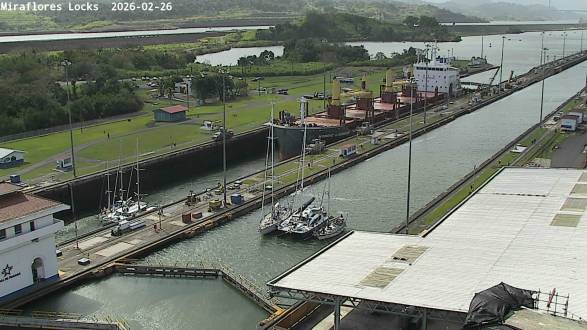

It is a strange experience, jumping from the Atlantic to the Pacific through a land mass. The engineering feet that is over 120 years old is still standing today, operating efficiently, closing and opening doors on gravity fed water to move boat and ships up and down across the small isthmus of Panama from one ocean to the other. The gates that close each lock are obviously old, resembling something out of the movie Water World, ridged and ornate at the same time. The pressure created by the water that fills the locks is what seals the closed doors. It’s tough to contemplate how it all works, but I can tell you it works, and it works well. This is a well oiled machine where the technology and logistics work seamlessly to push as many vessels across in both directions daily.

There is a lot of complexity to scheduling a transit through the Canal on a pleasure boat. It’s quite common for pleasure boats to transit, but very different from how a cargo or tanker ship goes through the locks. That said, pleasure boats will typically be coupled with a large commercial ship in the locks. During our experience, we had a cargo ship in front of us on the way up to Lake Gatun, and then one behind us on the way down to the Pacific.
We began our process almost a month prior to our transit. While not necessary, we decided to go with an agent. This makes everything easier. They help you clear into Panama, get your cruising permit, pre-pay for scheduled transits in order to fill openings as they come, provide rental lines and fenders, and give you an easy way to hire required line handlers if you cannot fine your own. In the end the cost of an agent is only a fraction of the total cost paid for the canal transit. In my opinion, the reduced stress of coordination is more than worth it for 10% of the total cost of a transit to hire an agent.
The agent sent us info on cost and all the info required to apply for a transit through the canal. It begins with measurements. You need to measure everything from total length and width, to weight and height. Additionally, there are required images to support all the info required.
Required Information to Apply For Transit:
- Prior transit? If yes, Sin number:
- Name of Yacht:
- Registered Length:
- Beam:
- Draft:
- Gross Tonnage:
- Nett Tonnage:
- VHF Call sign/letters:
- Registration number / Country / Issued date / expiration date:
- Speed:
- Hull Color:
- Type of sailing boat:
- Free board distance from water line to boarding deck:
- Air Draft (height water line to top of mast):
- Hull material:
- Last ten ports (10) with estimate departure date:
- Next port:
- Boat builder Name / Country / Year:
- How many engines / Brand / Horsepower:
- Serial number of each:
- Number of propellers:
- Type of propeller rotation:
- Owners address and telephone:
- Captain name: date of birth: nationality: passport #
- Crew on board: date of birth: nationality: passport #
- Confirm all crew on board are Healthy

Manual Measurements & Additional Questions:
- Fwd Extension: meters. anchor, bow
- Aft Extension: meters dinky, solar panels?
- Air draft: meter mast height
- Final overall length including extensions: meters
Extreme beam: meters - Fuel tanks capacity: gallons 1 or 2
Diesel for Transit estimate:
Comfortable speed:
RPM: - Below Boat Spec: YES or No
- Navigation light
- Bow thruster
- Gyro compass
- Bitts
- Awning
- AIS
- Cleats
- Vhf
- Radar
- Anchor
- Magnetic Compass.
Required Images for Reverie


Once our transit permit was approved, we had to show Panama that we were in Panama ready for a transit date. This typically requires a confirmation on AIS, or a photo the vessel is in Panama. Once that happens a transit date can be requested. All of this can be completed via the Panama Canal authority by yourself, but it requires more work and more phone calls, non of which I wanted to deal with. Waiting times for transit vary based on the season. The highest season for pleasure boats is March with February falling just behind.
Rallies always take precedent for transit scheduling. These are groups of boats moving around the world or across oceans together. The rally organizes all the formalities and the individual boat pays a cost to be a part of the group. Rallies are relatively common, typically for crossing the Atlantic, Pacific or smaller passages as groups that aim to have “buddies” and a community experience as they move around different parts of the world on sailboats. The rallies tend to push other pleasure craft down the line in the schedule as they always take precedent. It can be frustrating, but all boats have problems and this will cause boats to cancel their transit, opening up earlier opportunities for others.
A boat MUST be able to make 5-6 knots under engine power without issue during the entire transit. A delay to operations is a big deal and is avoided at all costs. Any issue with power could endanger the boat and those around you, as pleasure boats typically next together for the transit. Therefore your engine must be in ship shape, sails are not permitted. You have now turned into a power boat with a mast.
In addition to all this, there are other formalities. A pleasure boat must have 4 line handlers in edition to a captain. This means a minimum of 5 people on every boat regardless of its size or how it will be nested. It is mandatory for all vessels transiting the canal to have an advisor. This makes the total a minimum of 6 people required for any vessel. While it doesn’t seem like much, it’s unlikely a pleasure vessel goes through in 1 day. Therefore, you have to house at least 5 people overnight and 6 by day. The advisor will be swapped out on the other side of the lake for day 2. Requirements for commercial ships are very different and vary based on weight, size and maneuverability.
Ok so now we have to have a total of 6 people on a tiny 38’ boat that barely sleeps 4 comfortably, even if it claims otherwise…. On top of all this your advisor must be fed and watered. ONLY bottled water and HOT meals with meat are accepted. They say if you do not provide acceptable meals, bottled water, or a toilet with a door for privacy you will cause a delay and be charged. I was concerned about our composting toilet. While we “met the requirement,” I had a feeling it would cause a problem. It’s not a common marine toilet and the liquid portion holding tank is limited. We’ll get back to how my intuition came to be the truth later…

Once a transit date is set, you wait…. For us in February, we waited 10 days from the time we arrived in Shelter Bay Marina at the mouth of the canal until our transit date. As has been our marina experience to date, it’s a hot trailer park. Luckily the pool and other amenities at Shelter bay help ease the pain, but we were in “F” dock, the furthest in, which tends to collect the Sargassum and plastic trash, so it was not the most pleasant place to look at or smell. Regardless the only other option is waiting at the anchorage just outside Shelter Bay, and if you need to provision, drop trash, want a real shower, and pick up your line handlers you will have to pay to land your dinghy. For the 10 day wait, the marina seemed worth it, plus we needed some welding work done and this made it simpler. Had it been longer, we likely would have left to go cruise somewhere (San Blas) for a bit and come back.
While it’s always possible to be pushed or delayed even if you have a set date, it’s less likely with the agent. We even had the chance to transit earlier as a spot opened up 4 days earlier than our original date, but because our welding was not guaranteed to be completed, we didn’t want to chance losing our spot. We stuck with the plan and were glad we did because the welding was not done until a few hours before that earlier slot. It would have been scary tight, risking a fine if we canceled last minute.
Costs Of A Canal Transit:
The costs for a boat of our size are not cheap, but definitely don’t compare to what commercial ships pay. There’s tiered pricing for different sizes of pleasure yachts.


The above receipt are my actual costs. However, this does not include 3 more costs:
- Cruising Permit + $235 paid earlier
- Line Handlers X 3 + tip = $405
- Provisioning = $260
Total overall cost for a 38′ Monohull w/ agent, rented lines / fenders & 3 line handlers = $4,625
Ok now that the details are ironed out, here’s how it unfolded… We confirmed the need for 3 line handlers 2 days before my agent would provide at $120 each. We tried to get “volunteers,” and preferred a couple who we could put in the v-berth who wanted to experience the transit, but we were unsuccessful. It’s always helpful to experience it first, as it calm nerves and helps you understand what to expect. Many folks are looking for this. This is not unusual and quite common for boats to buddy up. Not sure if this was a timing issue or what but others seemed to find help or already had some and we struck out. There is a WhatsApp line handlers group, but you do need to be careful. YOU CANNOT PAY ANYONE THAT IS NOT PART OF PANAMANIAN LINE HANDLERS! This means be careful about backpackers or other non-nationals looking to make a buck. I think we struck out because we landed there right when the Oyster Rally was going through and there were less regular boats. Just as we were leaving it seemed the line handlers group had a lot more volunteers. In the end we were happy to not have to worry about what we were supposed to do as our line handlers did everything. There was a LOT of spanish flying around and everyone knew what to do, so it was nice to just have them do their thing and us worry about getting the boat to where it needed to be.
We provisioned 1 day before taking the Shelter Bay bus into Colon. Our planned meals:
- Dinner night 1: Chicken thighs with rice, Mexican type cheese, avocado, and beans
- Breakfast morning 2: Egg, Bacon, and Cheese burrito wraps + fruit
- Lunch day 2: Hot dogs (I know…), canned pork / beans, and fruit salad, plantain chips (these were a hit with our line handlers)
- Other requirements: Bottled water 2x cases (not completely consumed), assortment of soda (more of a friendly nice to have than a requirement)
Folks on the Shelter Bay WhatsApp claimed line handlers eat like football line backers, so we were a bit nervous, but it wasn’t too bad. they did polish every last bit of the dinner Tony made and ate all the snacks we put out.
Transit Date: February 25, 2026
Our agent : Erick Galvez – Centenario & Co S.A.
Day 1
- We were given transit time details 24 hrs before. Our advisor would board the boat at the anchorage at 17:00 night 1 and our transit would resume in Gatun lake at 8:00 the following day with a new advisor.
- Our line handlers would arrive to the marina at mid-day.
- 9am day of transit I checked in via VHF radio with Cristobal Signal to confirm my advisor boarding time.
- I decided to leave the marina early, ~2pm, to get to the anchorage and ensure our engine was running well and we had time to prepare our pre-cooked dinner
- We checked in with Cristobal Signal again 1 hour prior to advisor arrival to confirm our position and that we were ready for the advisor. This is when they updated the time to 17:30.
After our advisor boarded (~17:45), he explained to me what would happen very briefly. We would wait for the blue catamaran just aft of us, Full Circle, to pull anchor. We would then follow them at 5.5-6 knots toward the channel. Once at the locks we would raft up to either their port or starboard side, likely port. They would then take control of moving us forward into the locks as they have two engines. I would stand-by in case I had to aid with my engine. He asked if we had any questions. We asked when he wanted to eat dinner. He confirmed he would like to eat around 19:00. Our line handlers confirmed they would like to eat once in the lake on the other side of the locks.
We Proceeded to pull anchor and head out. I was told to keep within 3-4 meters of the red buoys and maintain speed. We went under the Atlantic side Bridge of the Americas and shortly came up to the locks. The first 3 locks up to Lake Gatun are one after another. I was told to idle while we waited for a few vessels to exit the locks. Then I waited for Full Circle to get into position. I was told to proceed to her port side and we would tie up with our dock line. The line handlers would take care of it all and I would just get the boat there. It was a bit tough to see since it was dark and spreader lights came on for the line handlers giving me slight night blindness, but I managed to get along side her just fine, no issue. Once rafted, we proceeded to the locks, me in Neutral, the captain of Full Circle moving us along. We were told we would have a cargo ship in front of us. We entered the lock, lines with monkey fists were thrown to our handlers from the walls. Our handlers attached them to the long lines provided by the agent, one at the bow, on at the stern on our port side. Full Circle would have the same on their starboard side. Once in position directly behind the cargo ship, lines were pulled to the walls and secured, Then the doors closed on the Atlantic and the water rose.
Since the Cargo ship was ahead of us it was relatively quick. The locomotives pull it into the next lock, and we followed behind after lines were released, monkey fist ends kept. The wall side personnel lead the skinny lines along while we motor into the next lock where the process is repeated until we were in the lake. The advisor and I ate dinner while inside the lock waiting for water to rise. Once in the lake, we departed from Full Circle’s port side and motored. Tony and the line handlers ate as we motored to our mooring. At this point is was at least 9pm.
The channel markers were well lit and our advisor instructed me well. As we approached the mooring field I was a little nervous. The spreader lights were still on and my night vision was bad. While I could see the lighted mooring buoys, I couldn’t see their size or shape. The advisor requested a flashlight and he went toward the bow to light it up. I caught a glimpse and an idea of how big it was. I was instructed to approach it on port. Literally seconds before it was there the line handlers jumped up from down below, one jumped onto the buoy, while the others helped with lines. We were secured, fenders between the HUGE buoy and the boat. The advisor was picked up just before 10 pm and we were informed our new advisor would join us at 07:30 tomorrow.


Day 2
Because our boat cannot accommodate sleeping 5 people down below, and it was compulsory for me to provide the line handlers a sheltered sleeping area, Tony and I slept in the cockpit. It threatened to rain in the beginning of the night which forced me to put our pillows in garbage bags and grab my foul weather gear as a blanket. I’m not sure I slept more than 3 hours since it was 11pm by the time we went to sleep and we woke up at 5:15am to ensure breakfast was started and we were ready for our 07:30 boarding. The advisor showed up just after 07:30 and half the line handlers were still sleeping. It had just rained so the cockpit was quite wet. The advisor immediately told me to start the engine and the line handlers were abruptly woken to release us from the mooring. Tony was working on breakfast. We left before Full Circle without any explanation of what was going to happen. I was told to point my bow toward the next red buoy.
I continued to get little instruction and we sped away from Full Circle. Breakfast was served and the line handlers went back to sleep. I stood at the helm following the red buoys closely. Every now and then my advisor would say “more to starboard please” / “more to port please.” At some point not long after breakfast he needed to use the head. He instructed me to stay close to the red buoys. I had Tony explain how to use our composting toilet. He was down there for a while. Lake Gatun is big and it was about a 25nm motor across, that much I knew, but I was confused why we sped away from our buddy boat and why I was gaining on another sailboat that had crossed through the mooring field earlier, likely from a very early morning Gatun lock transit. I had to ask what he wanted me to do when I continued to get closer to the other sailboat. I was told to overtake on their port side and he had already discussed with the advisor aboard that boat.

Another visit to the head was to follow not long after the first. I was getting nervous. At some point I had Tony take over the helm so I could use the bathroom. I happened to notice a lot of water on the floor, but didn’t think too much of it. I also noticed a bit of a mess in the bowl. The way our composting toilet works is it separates liquids and solids. To do number 1, you open the lid like any normal toilet and pee normally. The liquid drains into a small holding tank that requires emptying regularly. Honestly, this had been my major concern and I thought I was going to have to empty it into bottles since I couldn’t dump it overboard during this transit. We have never had this many people using our toilet before. To do number 2, you have to open a flap. You drop the kids off down the flap, put your TP in the trash can, close the flap and turn the handle. Simple, right? Apparently not.
We continued on and eventually I started coming up on another sailboat. I asked again and was told I might overtake them, so we continued on. Then just as I came up on their stern I was told to slow down and follow them. We would be mooring again on 3 more red buoys for around an hour or so. He explained this was a bow mooring and I should be careful not to hit it, but he gave me zero direction on which one I was going to. I continued on as he would tell me “straight” of “more to starboard” and finally one of the line handlers explained to me where we were going. We would go to the last mooring buoy. We tied up to the mooring, and waited. Tony prepared lunch. Just as Tony set out lunch I was told to start the engine. Our line handlers were risen from below to release us. We were underway again with little instruction but to follow Full Circle, who had met us at the mooring. The advisor went to use the head AGAIN… Again he was down there for a long time. I needed to pee and was waiting, when just after the advisor came out a line handler went in. I was worried. Once everyone was out Tony took the helm and I jumped down there.
What I would find would push me over the edge. Again I saw some water on the floor. It smelled so bad, I gagged. I went to pee and the bottle was already overflowing, there was what appeared to be pee all over the floor (later I would learn this was a mix of piss and shit). Essentially, it appeared they were likely not opening the flap, shitting in the toilet, then taking the sprayer from the sink and washing it down effectively defeating the entire compositing system and overflowing the liquid tank. I jumped out of there and screamed at everyone. “YOU DO NOT PUT WATER DOWN THE TOILET! IT’S A DRY TOILET. THERE’S PISS ALL OVER THE FLOOR! THE TOILET IS F*%$^#! IT’S ALL OVER MY FEET! F*$%#^” My temper tantrum continued for a moment. After all I had been standing in their feces and we explained how to use the toilet, yet somehow they took it upon themselves to not listen. In the end, I felt bad for my outburst but then I reminded myself they are likely used to this with latino women and so what. Now Tony and I got a fun present to deal with that they could walk away from. Tony proceeded to do what he could while we were underway and I took the helm back. It was a quiet remainder of our transit…

The lack of direction continued, and now I’m sure even more so since I lost it on everyone. We came up to the first lock and he waited to tell me to go to minimum speed until I couldn’t slow down enough to stay behind Full Circle. Then he told me to idle, but the wind was still pushing us. I had to turn around to get back behind Full Circle. We entered the locks and the advisor said I would raft up to Full Circle’s port side just like last night. Another boat would join us on Full Circle’s starboard side. Rafted together, Full Circle motored both boats to the front of the lock this time. A large ship came up behind us.
Once the ship was tight to our stern, the north doors closed and the water lowered. There was a lot more pressure on the lines, especially the stern end during lowering. The line handler was letting out just enough to keep the boat steady and I could feel the boat taking pressure.
Once through the first lock, we had a short motor to the final two locks, Miraflores. We stayed rafted and Full Circle did all the work. There was a tourist viewing area full of people when we pulled up to Miraflores South Gate. At least 100 people were watching us and other boats transit through the locks. We were pretty much at the Pacific and at this point could see it. It was almost over… At least the canal portion. We still had to motor to the anchorage, get rid of our advisor, blow up the dinghy, pull the outboard out of the garage, and dinghy our line handlers and rented gear into La Playita Marina. Then deal with our toilet mess. It was far from over…
We went through the last two locks, but it seemed to take longer since we were tired and we always had to wait for the large ship to be pushed / pulled by the locomotives up to our stern. That’s definitely the closest I hope I will ever be to the bow of a ship like that! Once through the lack of direction continued and for the next 45 minutes I was told “more to starboard please” then abruptly “hard to starboard” and “more to starboard please” without any explanation of what was to happen next. Finally he asked me to leave the channel on the starboard side and idle. We waited. I assumed he was being picked up, but he never told us that. Finally, the pilot boat came around and he was gone. I was relieved, 1 down, 3 to go. We motored to the anchorage, set anchor and proceeded to immediately prepare the dinghy. We got them into the marina in relatively quick order, two trips, one guy with the fenders and another with two guys and all the lines. Phew… Now the toilet, but it was also getting late and we were hungry. Luckily La Playita is basically Panama city, so we went out to eat, had a bucket of beer and returned looking forward to a good night sleep. But, back to the toilet first. I’ll spare the remaining details. The next day I felt like I had been run over by a truck. What mattered was that we were in the Pacific!


4 responses to “The Panama Canal Transit: Goodbeye Atlantic, Hello Pacific!”
what a shit show ? I would have exploded on them as well.
What a massive adventure! How long will you be in the Pacific? What’s your next destination? Assume you will eventually transit back through the canal?
I think we will be in the Pacific for quite some time as we will head west across it to the Marquesas in French Polynesia in early April once we get our new sails. I don’t know if we will ever go back through the canal. It’s an evolving adventure…
Sounds fantastic! We are enjoying following your sailing adventures and seeing the challenges you continually face and overcome. You’ve definitely earned your Pro Sailor patches. Papua New Guinea is just a little bit further west 😉